Every few years, someone announces that PHP is dead.
Then millions of developers continue using it to build websites, manage WordPress installations, create custom business applications, and make money from freelance clients.
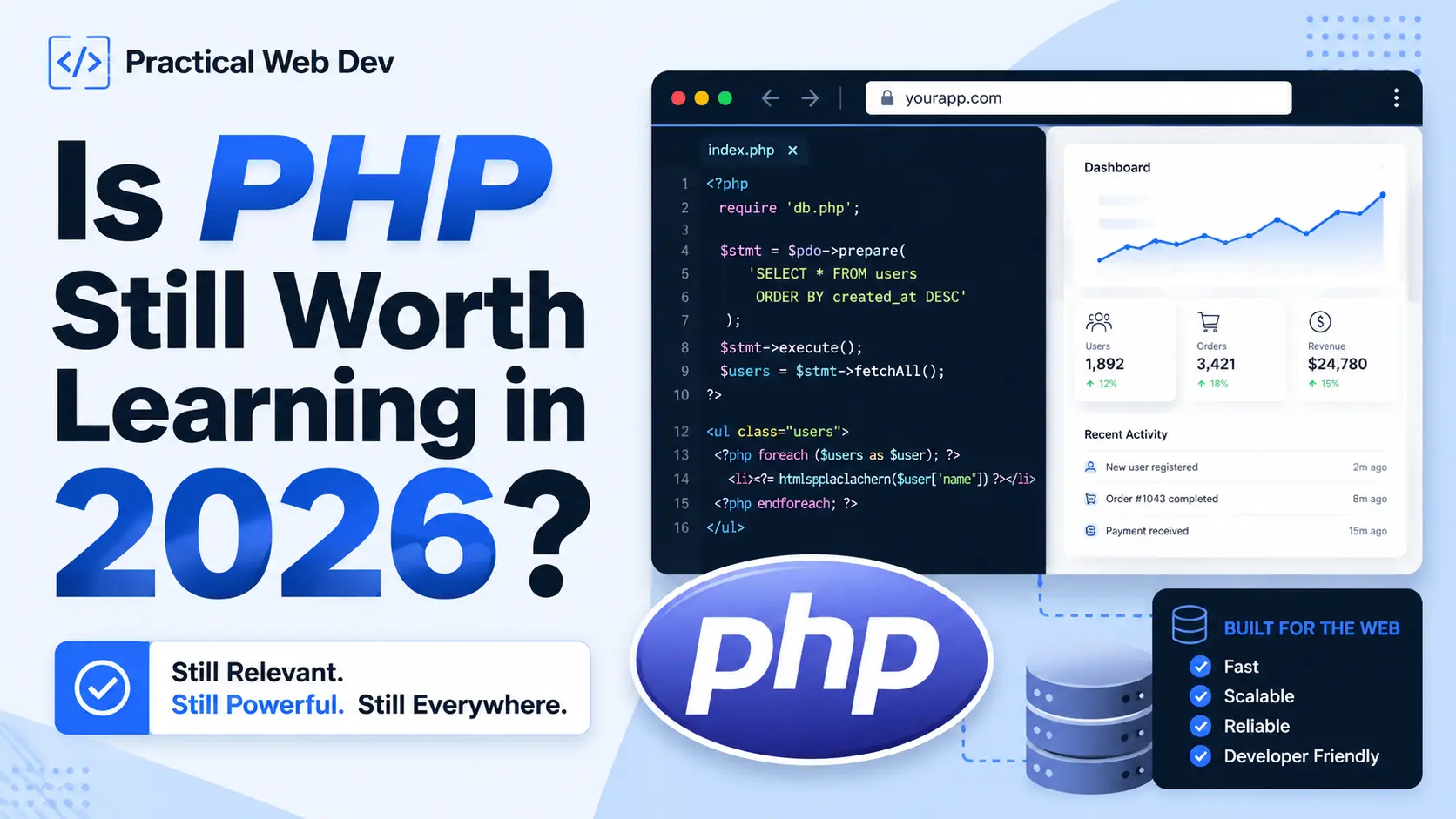
So, is PHP still worth learning in 2026?
Yes. PHP is absolutely still worth learning in 2026—especially if your goal is to become a practical web developer who can build real websites and applications for real businesses.
PHP may not be the newest or trendiest backend language, but that does not make it irrelevant. In many situations, PHP remains one of the simplest, most affordable, and most practical ways to add backend functionality to a website.
PHP Is Not Dead in 2026
Let’s start with the numbers.
As of August 3, 2026, PHP is used by approximately 70.5% of all websites whose server-side programming language can be identified. PHP 8 is also used by more than 62% of websites currently running PHP.
So when people say PHP is dead, they are usually confusing two completely different ideas:
- PHP is not currently the most exciting language on social media.
- PHP is no longer being used.
The first statement might be true depending on where you spend your time online. The second statement is obviously false.
PHP still powers a massive portion of the web.
That does not mean every new application should automatically be built with PHP. It does mean that PHP remains a valuable, marketable, and extremely practical skill.
PHP Is Still Actively Developed
PHP is not some abandoned programming language being kept alive by ancient servers.
PHP 8.5 was released on November 20, 2025, with additions including a built-in URI extension, the pipe operator, improved cloning syntax, and other language improvements.
PHP 8.5 is scheduled to receive active support through December 31, 2027, followed by security support through December 31, 2029. PHP 8.4 is also actively supported through the end of 2026.
The language continues to receive:
- Performance improvements
- Security updates
- New syntax
- Better type support
- Modern development features
- Regular maintenance releases
You are not learning an abandoned technology. You are learning a mature language with a huge existing ecosystem and an active development team.
PHP Was Made for Web Development
One of PHP’s greatest strengths is also one of the reasons some developers underestimate it: PHP was designed to make web development straightforward.
The official PHP documentation describes PHP as a language that is especially suited for web development and can be embedded directly into HTML.
That is a massive advantage for beginners.
You can create an HTML page, add PHP where dynamic behavior is needed, upload the files to a server, and run the application.
<!DOCTYPE html>
<html lang="en">
<head>
    <meta charset="UTF-8">
    <title>PHP Example</title>
</head>
<body>

    <h1>
        <?php echo "Welcome to my website"; ?>
    </h1>

</body>
</html>
You do not immediately need to configure a complicated frontend framework, a separate backend service, multiple build tools, containers, cloud functions, and a deployment pipeline just to display information from a database.
PHP works naturally with the technology websites already use.
You can combine:
- HTML for page structure
- CSS for presentation
- JavaScript for browser interactions
- PHP for server-side logic
- MySQL for storing data
That stack is enough to build a tremendous number of useful websites and applications.
And if you wanted to, you can have an entire full stack application (HTML/CSS/JS/PHP) run from a single damn index.php file.
Not that you’d want to, but it just illustrates how easily it integrates with frontend web technology.
WordPress Still Makes PHP Valuable
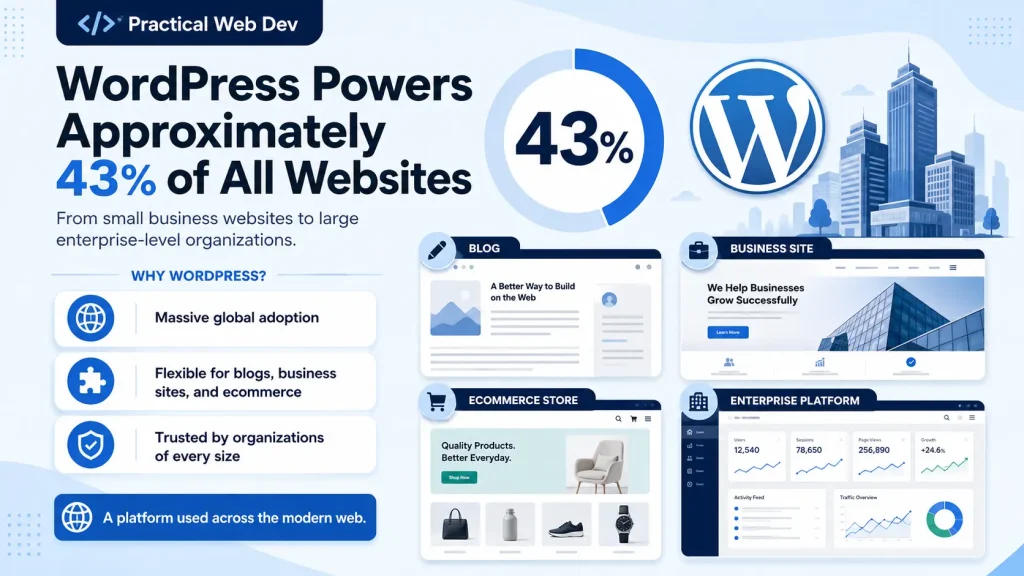
WordPress is one of the strongest reasons to learn PHP.
WordPress is written primarily in PHP, and a server must support PHP for WordPress to run.
Learning PHP allows you to go beyond installing themes and plugins. You can begin understanding what WordPress is actually doing behind the dashboard.
PHP knowledge can help you:
- Modify WordPress themes
- Create custom page templates
- Build custom plugins
- Add shortcodes
- Work with hooks and filters
- Create custom post types
- Process forms
- Connect external APIs
- Build custom administrative tools
- Troubleshoot broken themes and plugins
WordPress 6.9 is fully compatible with PHP 8.5, and WordPress currently recommends PHP 8.3 or later for production environments.
WordPress is not separating itself from PHP. Modern WordPress development still depends heavily on it.
A developer who understands HTML, CSS, JavaScript, and PHP can offer much more than someone who only knows how to install plugins through the WordPress dashboard.
PHP Hosting Is Easy to Find
Another major advantage of PHP is that deploying it does not need to become an engineering project.
Traditional shared hosting platforms have supported PHP for decades. Many include a control panel that lets you:
- Upload your project files
- Create a MySQL database
- Manage database users
- Change your PHP version
- Connect a domain
- Create professional email accounts
- Install WordPress
- Enable SSL
For example, cPanel includes tools for selecting the PHP version used by an individual domain and currently supports PHP versions through PHP 8.5.
For many small projects, deployment can be as straightforward as uploading your files into the correct directory and importing your database.
That matters.
A beginner should not need to become a cloud infrastructure specialist before publishing their first useful backend project.
More advanced deployment options are available when you need them. However, most beginner projects, portfolio applications, local business websites, and internal company tools do not require an unnecessarily complicated hosting setup.
PHP Is Excellent for Small-Business Development
Small businesses usually do not care which programming language you used.
They care whether their website works.
They want customers to be able to:
- Submit a contact form
- Request an estimate
- Schedule a consultation
- Create an account
- View products
- Make a reservation
- Join an email list
- Access customer information
- Manage leads
- Update website content
PHP is extremely capable of handling these tasks.
You can build a custom small-business website with HTML, CSS, JavaScript, PHP, and MySQL without introducing a dozen unnecessary dependencies.
That simplicity can make the project easier to:
- Develop
- Deploy
- Explain
- Maintain
- Transfer to another developer
- Host affordably
The goal of small-business development is not to prove that you know the most complicated technology stack.
The goal is to solve the client’s problem.
PHP Is Perfect for Learning CRUD Applications
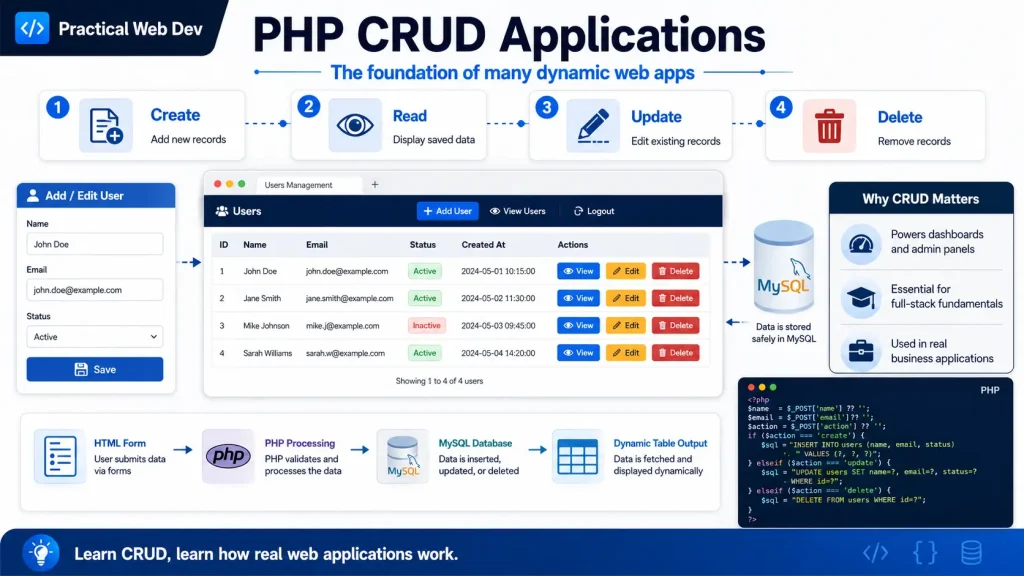
CRUD stands for:
- Create
- Read
- Update
- Delete
These are the four basic operations behind countless web applications.
Consider a freelance lead tracker.
The user needs to be able to:
- Create a new lead
- View existing leads
- Edit a lead
- Delete a lead
That is a CRUD application.
The same basic pattern appears in:
- Customer management systems
- Employee directories
- Inventory trackers
- Appointment systems
- Content management systems
- Student portals
- Project management tools
- Job application trackers
- Expense trackers
- Administrative dashboards
PHP and MySQL are excellent for learning how these applications actually work.
You can clearly see the relationship between:
- An HTML form
- A PHP processing file
- A database query
- A MySQL table
- A dynamically generated webpage
That direct connection is incredibly valuable when you are learning backend development.
Instead of hiding everything behind abstractions, PHP lets you understand how information travels through a web application.
PHP Is Still Useful for Freelancing
PHP remains especially valuable for freelance developers because freelance work is not limited to building brand-new technology startups.
Freelancers are frequently hired to work on existing websites.
A potential client may need someone to:
- Repair a WordPress website
- Modify an existing theme
- Fix a contact form
- Update an old PHP application
- Connect a website to a database
- Create a custom administrative page
- Add payment functionality
- Build a client portal
- Move a website to another hosting provider
- Troubleshoot a server error
There is an enormous amount of existing PHP code in the world.
That creates opportunities.
You do not always need to build an application from the ground up. Being able to understand, repair, modify, and extend an existing application is a valuable professional skill.
PHP can also be a great choice for creating affordable websites and internal tools for local businesses that do not need a massive custom software platform.
You Already Know More PHP Than You Think
PHP will be easier to learn when you already understand programming fundamentals through JavaScript.
The syntax is not identical, but the underlying ideas transfer.
If you understand these concepts in JavaScript:
- Variables
- Strings
- Numbers
- Arrays
- Conditional statements
- Loops
- Functions
- Objects
- Comparison operators
- Boolean logic
- Scope
- Error handling
Then you already understand a large part of programming.
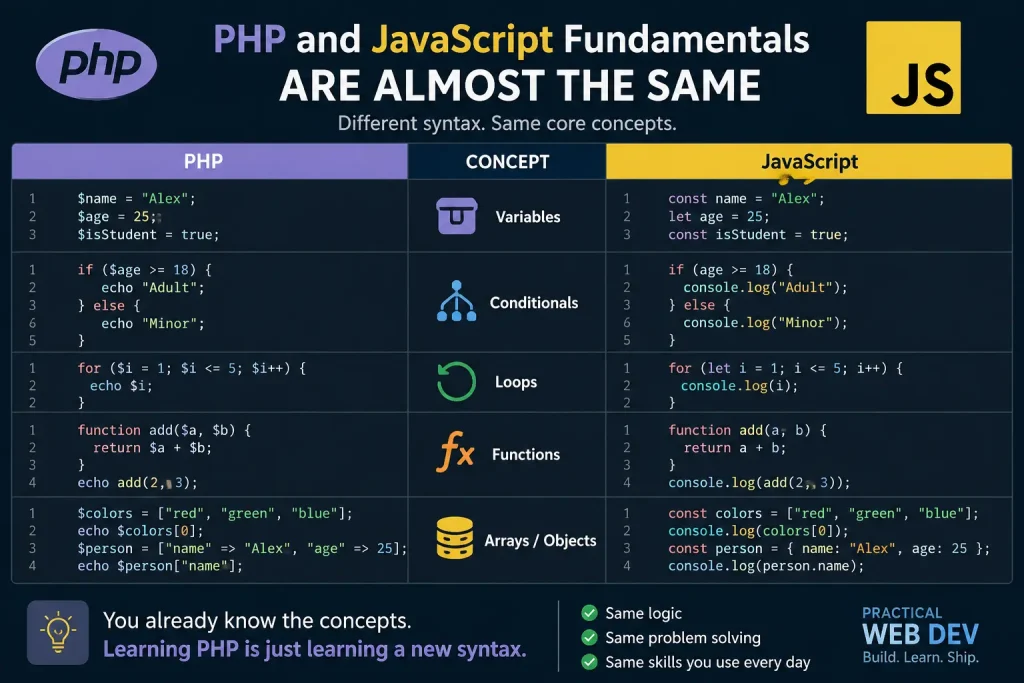
You are not starting over when you learn PHP.
You are learning how to express familiar programming concepts in another language while also learning new server-side concepts such as:
- Processing forms
- Working with sessions
- Authenticating users
- Connecting to a database
- Running SQL queries
- Protecting private pages
- Handling server requests
- Generating dynamic HTML
This is why learning programming fundamentals matters more than memorizing one specific language.
Once you understand how programming works, each additional language becomes easier to learn.
Beginners Do Not Need an Overcomplicated Backend Stack
Modern web development can become unnecessarily intimidating.
A beginner searches for information about building a basic application and immediately gets told to learn:
- A frontend framework
- A backend framework
- TypeScript
- Containerization
- Cloud deployment
- Serverless functions
- Multiple databases
- Authentication services
- State management libraries
- Automated testing platforms
- Continuous deployment pipelines
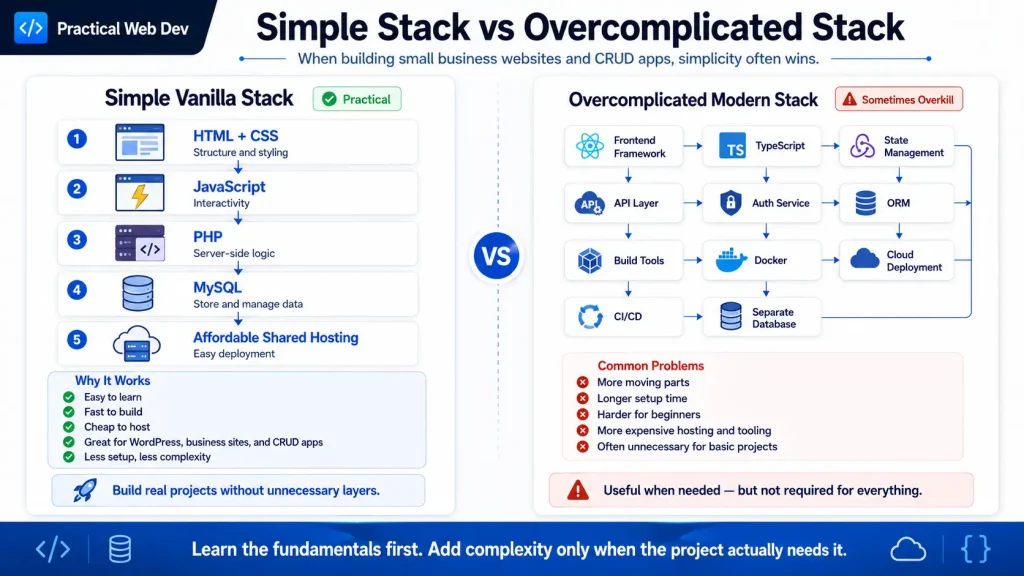
These tools can be useful. Some are necessary for certain professional environments and large applications.
But you do not need all of them to learn backend web development.
You definitely do not need them to build your first customer management system, lead tracker, login system, content dashboard, or small-business website.
Complexity should be introduced when a project requires it—not because someone on the internet told you that every application needs an enterprise-level architecture.
A simple PHP and MySQL application can teach you:
- How a server receives a request
- How form data is processed
- How information is stored
- How users are authenticated
- How database records are displayed
- How applications are deployed
- How frontend and backend code communicate
Those fundamentals will still matter if you eventually move to Laravel, Node.js, Python, Java, C#, or another backend technology.
What PHP Is Not the Best Choice For
PHP is useful, but it is not automatically the correct choice for every project.
You may choose another technology when:
- Your employer uses a different backend language
- You are targeting a specific job market
- Your application requires extensive real-time communication
- Your entire team already specializes in another ecosystem
- A particular framework provides a major advantage
- You are building a highly specialized system with different requirements
Learning PHP does not require pretending every other language is bad.
JavaScript, Python, Java, C#, Go, Ruby, and other languages all have valid uses.
The question is not whether PHP is the only backend language worth learning.
The question is whether PHP remains useful enough to justify learning in 2026.
The answer is clearly yes.
Who Should Learn PHP in 2026?
PHP is a strong choice when you want to:
- Become a full-stack web developer
- Build dynamic websites
- Learn backend fundamentals
- Create WordPress themes or plugins
- Develop custom business applications
- Build CRUD projects
- Work with MySQL databases
- Freelance for small businesses
- Maintain existing websites
- Deploy projects without unnecessary complexity
It is especially useful for someone who already understands HTML, CSS, and JavaScript and wants to add server-side development to their skill set.
Is PHP Worth Learning for a Job?
That depends on the jobs you are targeting.
Look at job postings in your area and determine which technologies employers are requesting. Some markets will have more PHP opportunities than others.
However, PHP can provide value even when your eventual job does not use PHP.
Building applications with PHP teaches transferable skills:
- Backend logic
- Database design
- Authentication
- Form processing
- Application architecture
- Debugging
- Server-side security
- Deployment
An employer may use another backend language, but the core concepts do not disappear.
A database query is still a database query. Authentication is still authentication. Request processing is still request processing.
The syntax and tools may change, but the underlying development skills remain valuable.
Is PHP Worth Learning for WordPress?
Yes.
Learning PHP is one of the best ways to move from being a basic WordPress user to being an actual WordPress developer.
Page builders and plugins can accomplish a lot, but eventually you will encounter a feature that cannot be solved cleanly through the dashboard.
That is where coding knowledge becomes valuable.
PHP gives you the ability to understand and modify the server-side foundation that WordPress is built upon.
Is PHP Worth Learning for Freelancing?
Yes.
PHP is especially practical for freelancers who want to work with:
- WordPress websites
- Local businesses
- Custom forms
- Existing websites
- Membership systems
- Administrative dashboards
- Database applications
- Affordable custom development projects
Clients rarely care whether your technology stack receives approval from developers on social media.
They care whether you can deliver a reliable solution at a reasonable price.
Final Verdict: PHP Is Still Worth Learning in 2026
PHP is not dead.
It remains actively maintained, supports modern development, powers a huge portion of the web, works naturally with HTML, runs WordPress, integrates easily with MySQL, and can be deployed through widely available hosting platforms.
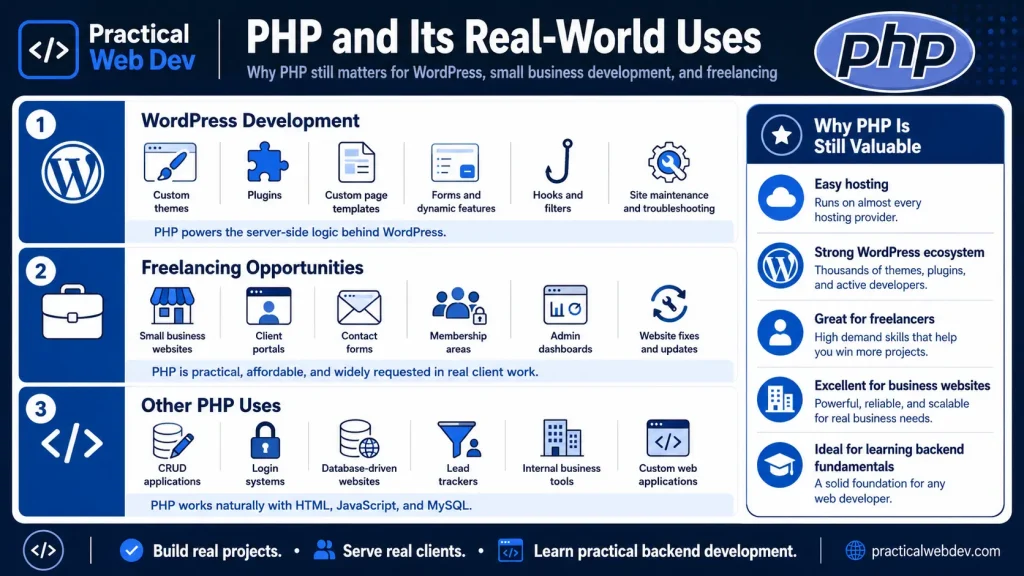
More importantly, PHP is practical.
It allows beginners to learn backend development without immediately getting buried beneath an unnecessarily complicated technology stack.
You can use PHP to build:
- Login systems
- Contact forms
- Lead trackers
- Customer portals
- Content management systems
- WordPress themes
- WordPress plugins
- Administrative dashboards
- Complete CRUD applications
You can publish those projects, show them to employers, use them in your portfolio, or sell them to clients.
That is the entire point of learning web development.
Do not choose a language solely because it is fashionable. Choose a language that helps you understand programming, build useful projects, and solve real problems.
In 2026, PHP still does all three.
Learn the Foundations of Full-Stack Development
The Practical Web Dev Coding Foundations program teaches the foundational skills you need to build complete websites and web applications.
You will learn:
- HTML and CSS
- JavaScript programming fundamentals
- PHP backend development
- MySQL databases
- User registration and login systems
- CRUD applications
- Complete project development
- How frontend and backend technologies work together
The goal is not to overwhelm you with every tool in modern web development.
The goal is to teach you how code works so you can build real projects, understand AI-generated code, and continue learning new technologies throughout your career.