There is this idea floating around right now that freelance web development is dead.
AI can write code.
ChatGPT can build websites.
Business owners can use Wix, WordPress, Squarespace, AI website builders, templates, page builders, and a million other tools.
So apparently nobody needs a web developer anymore.
Guys, I don’t buy it.
And instead of sitting here arguing about it for 3,000 words, I decided to actually test it in the real world.
I found a legitimate small business in my local area that didn’t have a website.
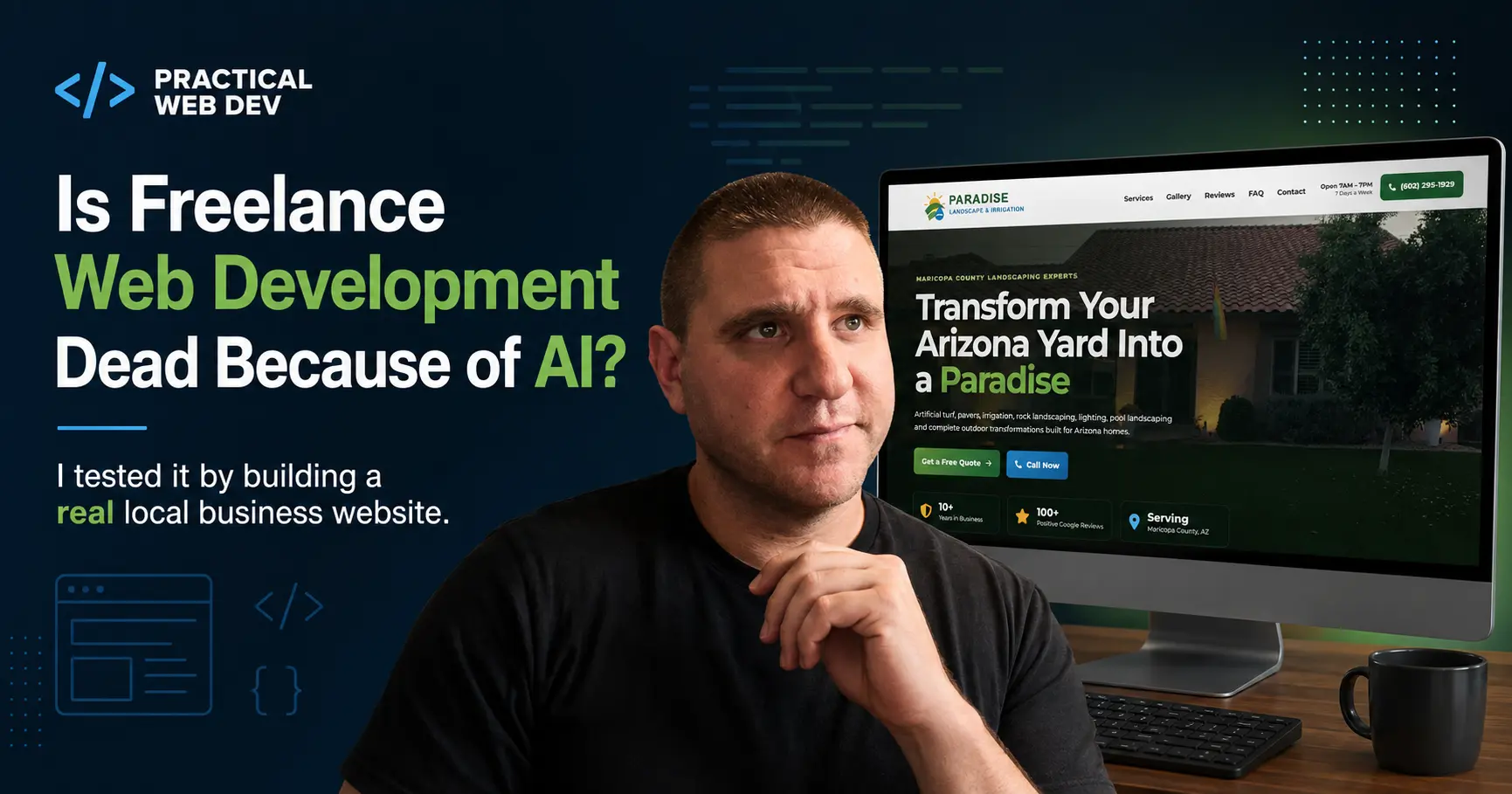
I took their real business information and photos, combined them with my existing source code, coding knowledge, and AI prompting workflow, and built them a professional website prototype.
Then I put it live on the internet and contacted the business.
The entire process took roughly 20–30 minutes.
And that’s exactly why I think AI isn’t killing freelance web development.
It’s changing it.
AI Didn’t Invent DIY Websites
This is the first thing that drives me nuts about this whole argument.
People talk about AI as if 2026 is the first time business owners have ever been able to build their own websites.
It’s not.
We’ve had WYSIWYG editors since the 1990s (What You See Is What You Get editors).
Then came things like:
- WordPress
- Wix
- Squarespace
- Weebly
- Shopify
- Drag-and-drop page builders
- Prebuilt themes
- Website templates
- Cheap shared hosting
- YouTube tutorials
For decades, a motivated small business owner has technically been able to sit down and figure out how to make a website.
And yet freelance web developers, WordPress developers, web designers, agencies, marketing companies, and enterprise development teams didn’t magically disappear.
Why?
Because being able to do something yourself and actually wanting to do it yourself are two completely different things.
Joe the Plumber Does Not Give a Shit About DNS Records
This is what people who spend all day online arguing about AI and web development forget.
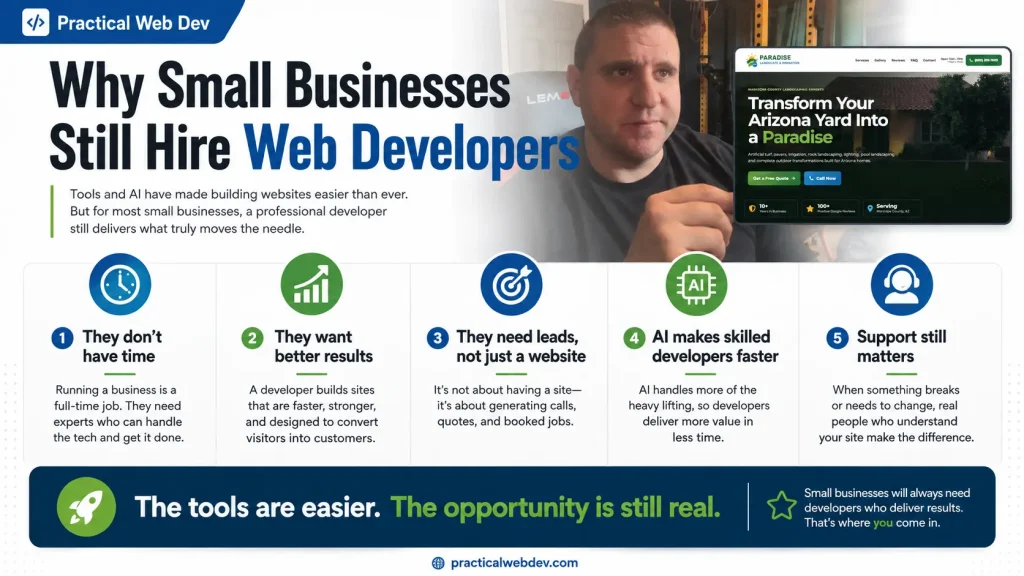
Real business owners have businesses to run.
Joe the plumber might have spent 10 or 12 hours working on a commercial plumbing job.
Then somebody calls because a toilet exploded at 9:30 at night.
Do you really think Joe goes home afterward and says:
You know what sounds fun? I think I’m finally going to learn DNS configuration tonight.
Come on.
The landscaper here in Arizona might have spent his entire day outside in 110-degree heat trying to get through five jobs before the hottest part of the afternoon.
He wants to go home.
He wants some food.
Maybe he wants a beer.
He wants to spend time with his family.
He probably doesn’t want to learn HTML, CSS, responsive design, web hosting, domains, conversion optimization, AI prompting, and deployment.
Could he?
Sure.
That’s not the point.
The point is that most people want the path of least resistance.
If somebody can solve the problem faster and better for a reasonable amount of money, that’s an attractive trade.
That’s why businesses outsource things.
Giving Everybody AI Doesn’t Make Everybody a Web Developer
This is another huge misconception.
Yes, anybody can open ChatGPT and type:
Build me a website for my plumbing company.
And ChatGPT will spit something out.
That’s incredible.
But now compare that to somebody who understands:
- HTML
- CSS
- JavaScript
- responsive layouts
- website structure
- calls to action
- lead generation
- hosting
- domains
- source code
- debugging
- accessibility
- user experience
- basic marketing
Those two people are not going to get the same result from AI.
That’s the part people miss.
AI amplifies the person using it.
If you don’t know what you want, you can’t accurately tell AI what to build.
If you don’t understand the code, you don’t know whether the output is good.
If you don’t understand websites, you don’t know what’s missing.
A random business owner might ask:
Make me a landscaping website.
A developer might specify the business type, target customer, service area, conversion goal, hero structure, CTA placement, mobile layout, testimonials, services, FAQ, lead form, brand colors, imagery, existing source code conventions, and deployment requirements.
Same AI. Completely different operator. Completely different result.
AI Actually Makes Skilled Web Developers More Valuable
This is where I think people have the whole thing backward.
AI didn’t make me slower.
It didn’t make me less capable.
It made me ridiculously faster and 10x more capable.
Ten years ago, building a custom small-business website could easily eat up an entire day or multiple days depending on what you were doing.
Now I can take source code from something I’ve already built, provide the AI with business information and assets, explain exactly what I want, and get a very strong first draft almost immediately.
Then I use my developer knowledge to inspect it, modify it, test it, deploy it, and turn it into something usable.
That changes the economics of freelancing.
Imagine something used to require 10 hours of production work and now you can create the first professional draft in an hour.
The customer still gets the thing they need.
But your production cost (time) just collapsed.
That’s leverage.
So I Decided to Test This With a Real Business
Enough theory.
I wanted to actually demonstrate the workflow.
I searched for landscaping businesses near me here in Arizona.
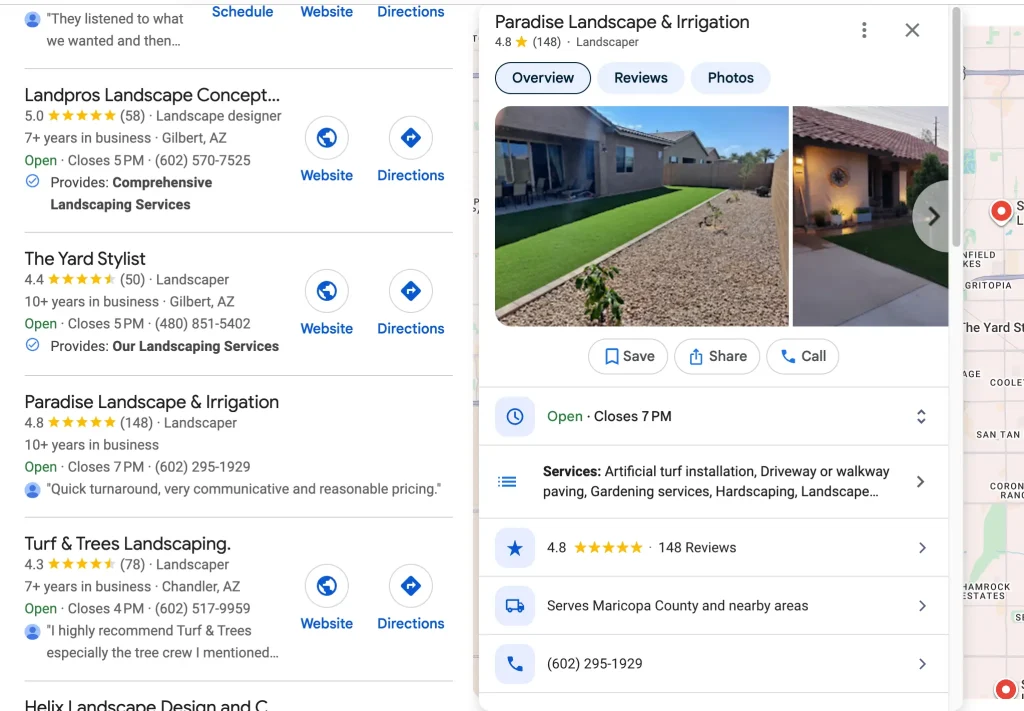
Eventually I found Paradise Landscape & Irrigation.
This wasn’t some fake business I invented for a portfolio project.
They had been operating for more than 10 years, had a 4.8-star Google rating with around 148 reviews, real photos of their work, a real phone number, real customers…
…but they didn’t have a proper website.
That’s exactly the type of prospect I would look for if I were actively trying to build a freelance client base.
They already have proof that people want their service.
I’m not trying to convince somebody to start a business.
I’m helping an existing business improve its online presence.
I Built the Website Before Contacting Them
This is probably one of the biggest lessons from this entire experiment.
I did not call them first and say:
Hey, I’m a web developer. Would you like me to build you a website?
That’s easy to ignore.
Instead, I built something first.
I gathered several real images of their work that were already publicly available through their Google business presence.
I collected their:
- services
- business hours
- phone number
- service area
- reviews
- years in business
- existing imagery
Then I gave AI that information along with my own HTML, CSS, and JavaScript source code so it had a reference for how I like projects structured.
That matters.
I’m not just pushing a magic button and hoping something good happens.
I’m directing the project with my own expertise and coding preferences.
The First Draft Was Already Pretty Damn Good
Once I had the information together, I generated the first version.
There were obviously things I wanted changed.
For example, the first version included PHP functionality for the quote form, and I wasn’t ready to build the backend yet.
No problem.
I told AI I only wanted the frontend for the prototype.
Then I opened the code in VS Code and checked it myself.
The structure looked good.
The responsive behavior looked good.
The media queries made sense.
The code followed the general style of the source code I provided.
Then came the moment of truth.
I launched it.
And honestly?
It looked legit.
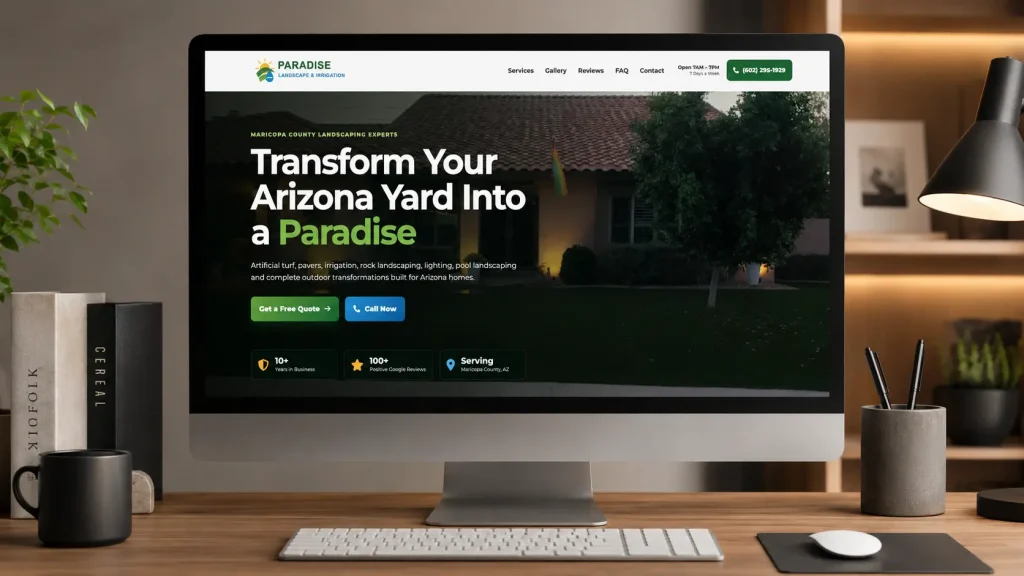
The finished landing page included:
- a custom Paradise Landscape & Irrigation logo
- their real phone number
- their actual business hours
- service information
- their real project images
- responsive mobile design
- a strong hero area
- trust signals
- Google review information
- clear calls to action
- a quote section
- a prominent Call Now button
This wasn’t some useless coding exercise.
It was a website designed around an actual business objective:
Generate leads.
That’s what you’re really selling.
Not HTML.
Not CSS.
Not PHP.
Results.
A Small Business Doesn’t Really Want a “Website”
This is an important mindset shift if you want to make money freelancing.
The landscaping company doesn’t wake up excited because it owns five HTML files.
They want:
phone calls.
quote requests.
customers.
jobs.
The website is simply a tool that helps produce those outcomes.
That’s why I built the prototype around lead generation.
Prominent phone number.
Call button.
Quote request.
Services.
Trust signals.
Reviews.
Local messaging.
Mobile responsiveness.
You need to start thinking like somebody solving business problems instead of somebody selling code.
I Put the Website Live for Free
Once I was happy with the prototype, I deployed it using Netlify.
Now I had something much more powerful than screenshots.
I had a real URL.
The owner could click a link on his phone and actually experience his potential website.
That’s a completely different pitch.
Instead of:
I can build you something.
It’s:
I already built this. Take a look.
That removes a huge amount of friction.
Then I Actually Called the Business
Now we had to see whether this works outside of a coding tutorial.
So I called.
And…
Nobody answered.
😂
It was Sunday, so I wasn’t particularly shocked.
I could have ended the experiment there and still made the same point.
The entire workflow had taken me roughly 20–30 minutes.
If you’re deliberately prospecting for freelance work, you could repeat this process.
Build a prototype.
Contact the business.
No answer?
Follow up.
No interest?
Move on.
Build another.
This is sales.
You’re not going to close every business you contact.
Then Something Happened I Wasn’t Expecting
About an hour later, my phone went off.
The business texted me:
“Hi there did you need help”
Holy shit…
So I responded.
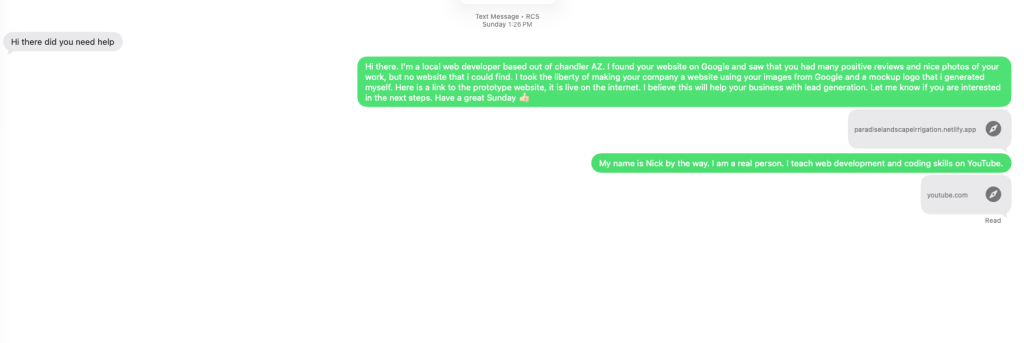
I explained that I was a local web developer, that I had found their business online, saw their work and reviews, and noticed they didn’t have a website.
Then I told them the important part:
I had already built them one.
I sent the live prototype.
I also sent my Practical Web Dev YouTube channel so they could see that I’m an actual developer who teaches this stuff publicly.
Now the website was sitting directly in front of a real business owner.
At the time I’m writing this article, they haven’t responded again.
And that’s fine.
Because that’s also real freelancing.
Sometimes people answer.
Sometimes they don’t.
Sometimes they look at something and come back three days later.
Sometimes they reject you.
Sometimes they buy.
The goal isn’t to build one website and expect money to magically fall out of the sky.
The goal is to create a repeatable system.
Freelancing is a Numbers Game
Suppose you can produce a legitimate personalized prototype extremely quickly.
You might contact several businesses in a day.
Some will never respond.
Some will tell you they’re not interested.
Some already have somebody handling their website.
Some will think you’re trying to scam them.
That’s reality.
But eventually you’re looking for somebody who says:
How much?
That’s the conversation you want.
And now you’re negotiating from a completely different position because they’ve already seen your work applied to their business.
You’re not asking them to imagine what you might build.
They’re looking at it.
What Should You Charge?
There’s no universal number.
A simple local-business landing page might be worth $500.
Maybe $750.
Maybe $1,000.
Maybe substantially more depending on the business, functionality, scope, market, and the additional work involved.
The mistake is thinking:
AI helped me make this quickly, therefore it must be cheap.
No.
Businesses don’t pay you based on how many times you pressed your keyboard.
They pay for the value of the solution.
If a website helps a contractor land several additional jobs, that can easily be worth many times what they paid for the site.
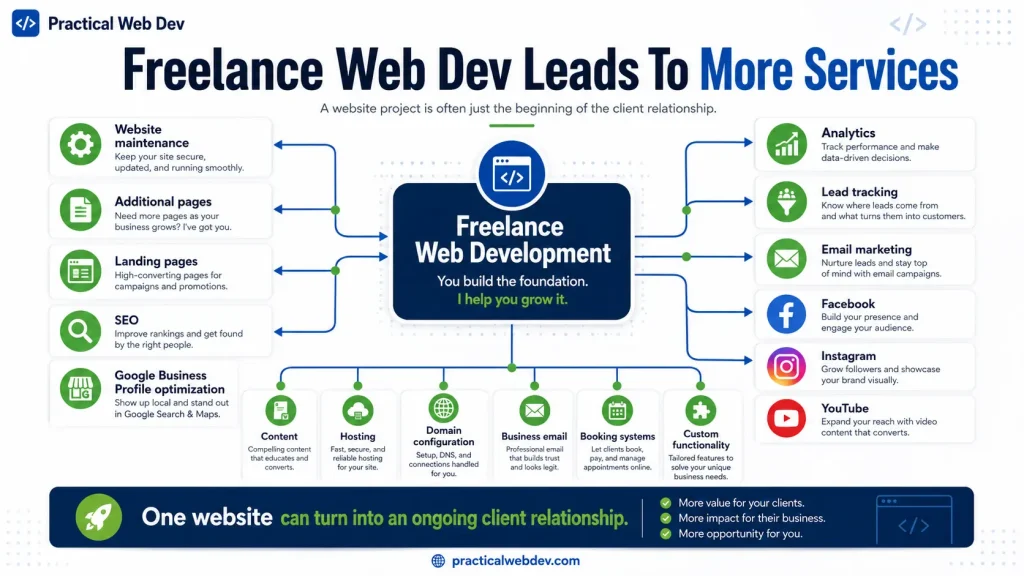
The Website Can Be the Beginning of the Client Relationship
This is another reason I don’t think freelance web development is dead.
Building the initial website can open the door to much more.
A small business may eventually need help with:
- website maintenance
- additional pages
- landing pages
- SEO
- Google Business Profile optimization
- analytics
- lead tracking
- email marketing
- YouTube
- content
- hosting
- domain configuration
- business email
- booking systems
- custom functionality
You don’t have to become some gigantic marketing agency overnight.
The point is that technical problem-solving creates relationships.
Solve one problem well and businesses may trust you with another one.
Coding Foundations Still Matter in the AI Era
Here’s the part of my position that sometimes gets lost.
I’m extremely bullish on AI.
I use it constantly.
I’m not telling you to sit there manually typing 1,500 lines of CSS because that’s what “real programmers” supposedly do.
That’s stupid.
But I also don’t think you should know absolutely nothing and expect AI to turn you into a professional developer overnight.
Learn enough HTML, CSS, JavaScript, backend development, databases, hosting, and general web fundamentals that you understand what you’re building.
Then use AI.
That combination is extremely powerful.
Foundations + AI + actual projects.
That’s the modern workflow.
Stop Building Fake Portfolio Projects Forever
If your goal is freelancing, eventually you need to stop building imaginary projects for imaginary companies.
Build something real.
You don’t necessarily need permission to create a prototype.
Find a legitimate local business with a weak online presence.
Build a mockup.
Don’t impersonate them.
Don’t publish misleading information.
Don’t pretend they hired you when they didn’t.
Simply create a demonstration of what you could do for them.
Then show it to them.
Worst case?
They say no.
You still built something.
You practiced.
You improved your AI workflow.
You gained another portfolio example.
You learned how to prospect.
You got more comfortable talking to businesses.
Then you do it again.
So, Is Freelance Web Development Dead?
No.
Not remotely.
But I do think old-school web development is changing fast.
The developer who refuses to use AI and spends three days manually producing something another competent developer can produce in three hours is going to have a harder time competing.
That’s reality.
But the opposite conclusion — that AI means nobody will ever pay developers again — makes no sense either.
Businesses still have problems.
They still need websites.
They still need leads.
They still need integrations.
They still need technical support.
They still need people who understand what the hell they’re doing.
AI simply gives us better tools for solving those problems.
And if you’re willing to combine technical skills with AI, sales, communication, and actual business problem-solving?
I think there’s still a massive opportunity.
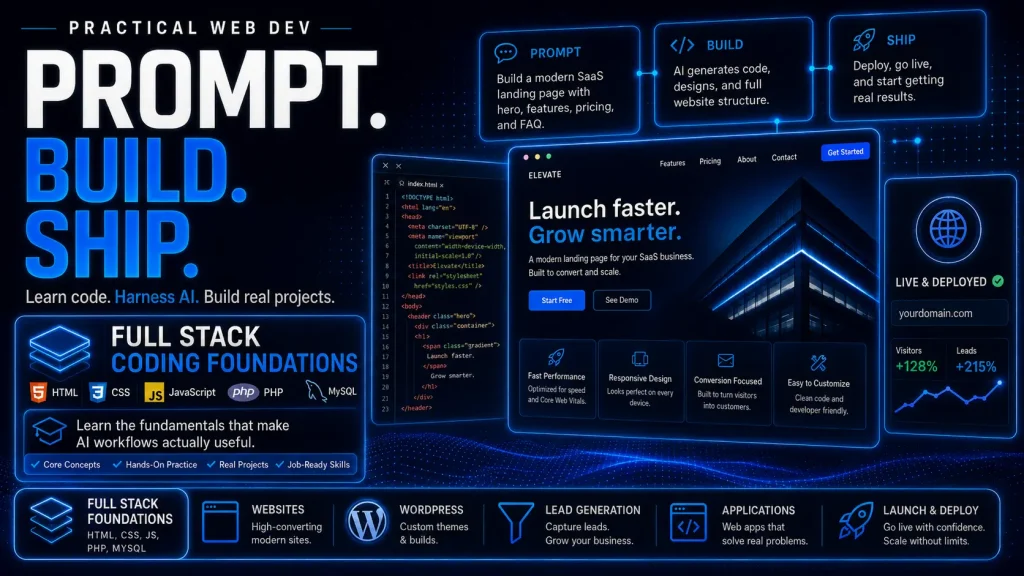
Want to Learn This Workflow?
This is exactly the kind of modern web development I teach at Practical Web Dev.
You still need foundations.
But you also need to understand how to combine those foundations with AI so you can build faster, solve real problems, and actually turn your skills into something useful.
That’s what Prompt, Build, Ship is about.
Learn code. Harness AI. Build real things. Ship them.
And if you’re still sitting around asking yourself whether AI has made learning web development pointless:
Stop asking.
Build something.
Find somebody who needs it.
And see what happens.